Performance benchmarking
As documented in our 2025 paper, we perform an empirical comparison of four major MEV protection RPCs—MEV Blocker, Flashbots, Blink, and Merkle by evaluating their execution quality for the exact same transactions. Through a systematic analysis of transaction outcomes, we examine how their different OFA designs impact user benefits, shedding light on how order flow providers should carefully pay attention to marketing claims and thoroughly review to whom they are sending their transactions to.
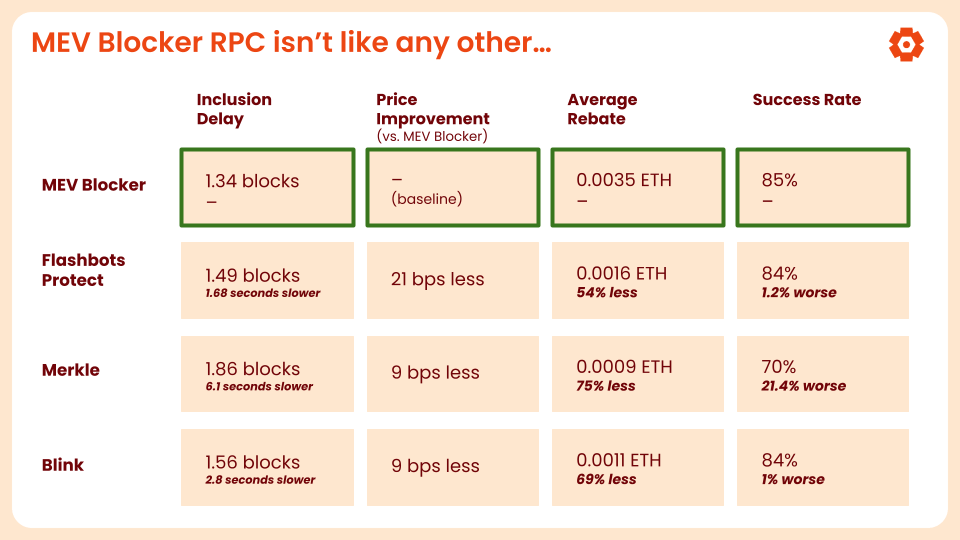
From these comparisons, we can rank each RPC service provider based on the different metrics. MEV Blocker stands out for being the only RPC that is either the best or among the best in all metrics. Flashbots ranks similarly or just below MEV blocker in time to inclusion and backrun value. However, its execution price is the lowest among all RPCs. Finally Merkle and Blink both generate low rebates. Also, Merkle's low success rate is notable.
Backrun quality
First, we measure the backruns generated by the RPCs:
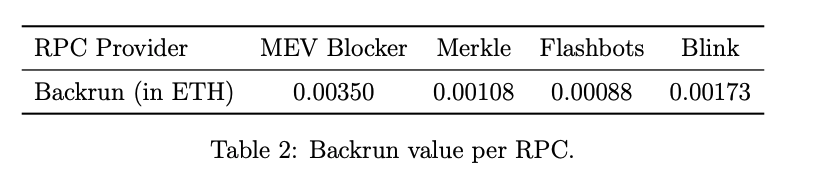
We follow a similar methodology as for swap price improvements: we compare between each RPC solution and MEV Blocker, and only consider swaps that landed onchain both via MEV blocker and via at least another RPC.
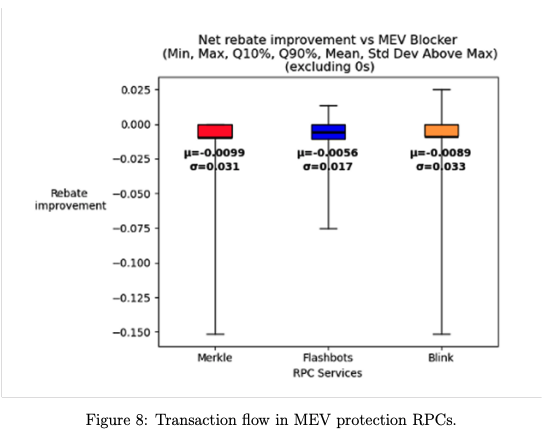
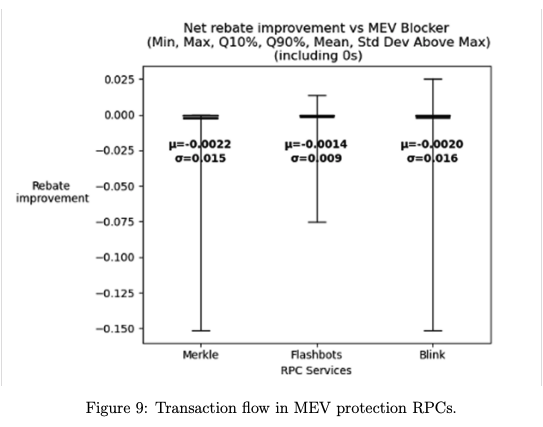
We plot a similar box plot as previously. The first plot represents the average backrun, and its distribution for all the transactions. The second plot only includes transactions where one of them (MEV Blocker or the RPC) has a non-0 backrun.
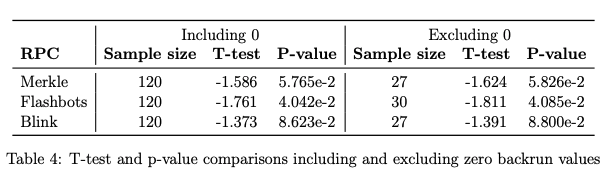
The swaps can be classified in 2 categories: very liquid pairs (ETH-USDC) and less liquid pairs (ETH-GNO, ETH-COW, and ETH-AAVE). The liquid pairs did not generate any backruns, which leads to many 0 values. Indeed, for these pairs there is enough liquidity so that one trade of reasonable size does not unbalance the pool enough to create an arbitrage opportunity. Additionally, even the less liquid pairs don't generate backruns every time. Therefore, we plot the values with and without the transactions with no backrun. For this analysis, we find that MEV Blocker's backruns are larger than any other RPCs solutions with more than 10% confidence.
However, if we look at the backruns received by the users, the values are different as Blink and Merkle don't send these backruns back to the user:
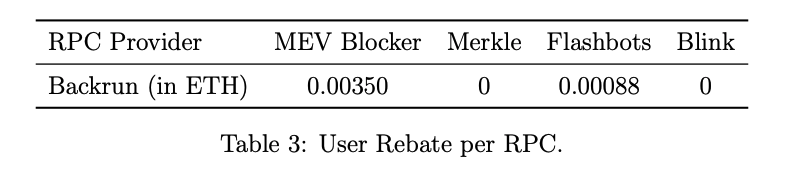
The comparison between MEV Blocker and Flashbots remains unchanged, because both RPCs send 100% of the rebates to their users. However, we can conclude that MEV Blocker and Flashbots are better for the users than Merkl and Blink, in terms of rebates value.
Inclusion speed
We now consider the number of blocks between submission and inclusion for the transactions which were successfully executed onchain. Here, we consider all the successful transactions for each RPC provider, as defined for the success rate.
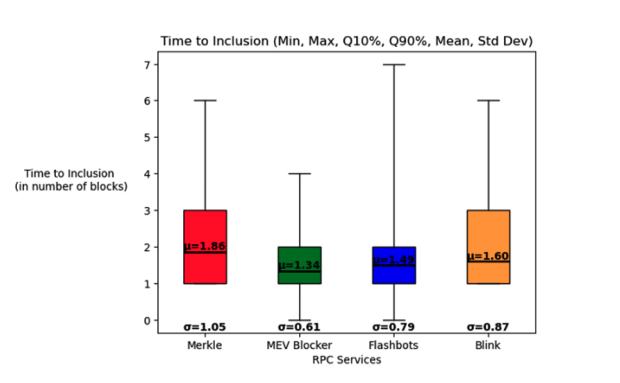
We plot the box plot of the distribution to time to inclusion (measured in number of blocks), with the minimum, the 10th percentile, the average, the 90th percentile and the maximum value. represents the standard deviation of the each set.
We notice that the mean and standard deviation rank the RPC service providers in the same order. This transaction sample demonstrates that MEV Blocker has the fastest execution, followed by Flashbots, then Blink and finally Merkle.
Flashbot's execution shows a single large outlier with a time to inclusion of 7 blocks, where the second largest is 4 blocks. This value does not significantly affect the mean and standard deviation, as the sample size is significant enough to compensate for it. With this detail accounted for, the box plot shows consistent performance results.
Swap price improvement
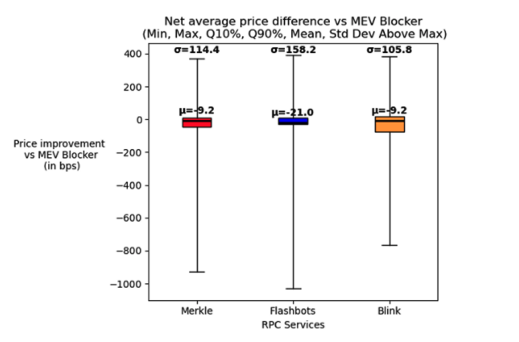
Focusing only on the swaps, we start by observing the quality of the execution which can be measured by the relative price of the swap between the different executions. Here, we compare each RPC service to MEV Blocker, when both have executed the swap. For every trade, we compute price improvement = price(RPC)/price(MEV Blocker) -1, and we measure it in bps. This can be rewritten price improvement = output(RPC)/output(MEV Blocker) -1, with output the amount of tokens received from the swap. Both formulas are similar because the inputs of the transactions are identical. The results show that, on average, MEV Blocker performs better than all other RPCs: it is on average 9bps better than Blink and Merkle, and 21 bps better than Flashbots.
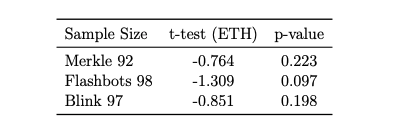
We also check the statistical significance of our results by performing a t-test with "H0: price improvement = 0." Intuitively, the p-value computed by this test represents the probability that, in truth, there is no difference between MEV blocker and the comparison RPC, and therefore the difference we measure in our data is purely random noise. This probability is below 10% for Flashbot, meaning that the difference between MEV blocker and Flashbot is statistically significant at the 10% level. The difference between MEV blocker and the other two RPCs instead is not significant at any standard significance level.
Success rate
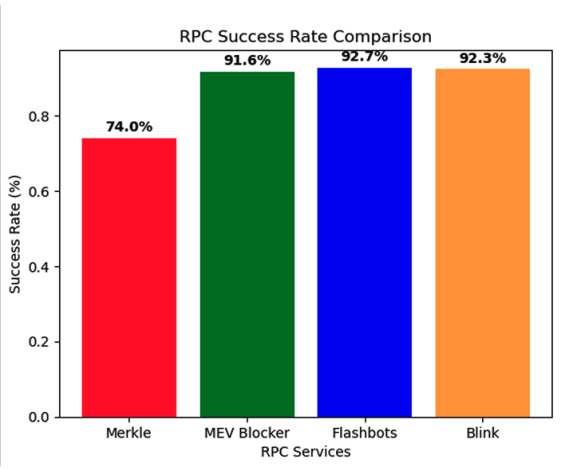
We define the success rate as the number of transactions that were successfully executed onchain divided by the number of transactions submitted through an RPC. This implies that all transactions which landed onchain but reverted are considered as unsuccessful. Out of the 273 transactions submitted, MEV Blocker, Blink and Flashbots successfully executed their transactions with a rate of exceeding 90%, while Merkle's success rate was lower at 74, we assign one color to each RPC that we'll keep for the following plots.